
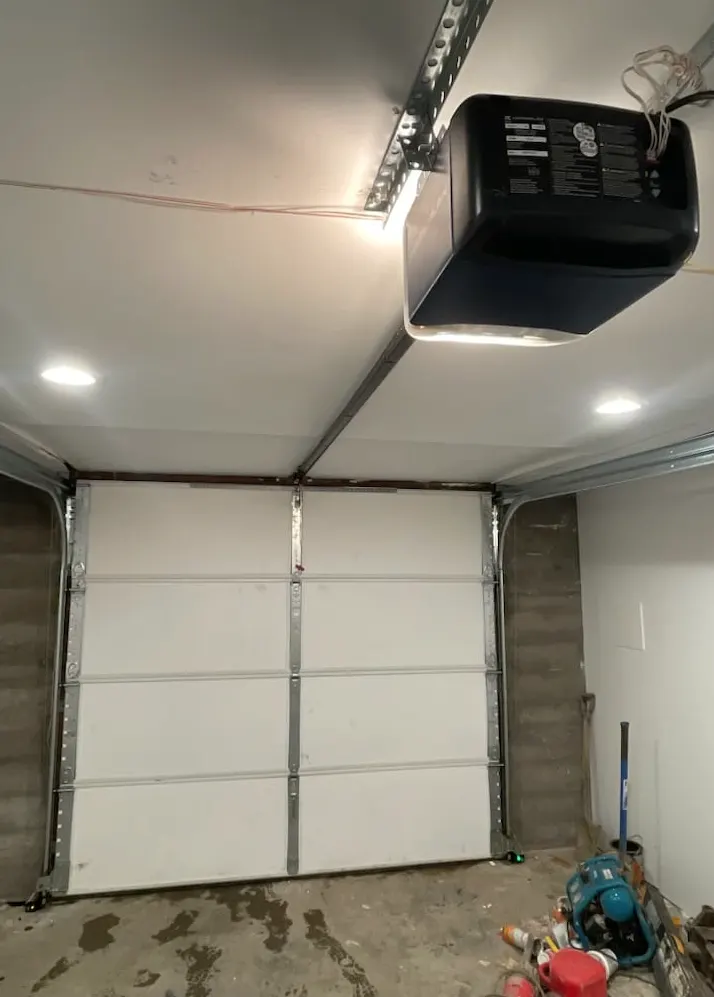
What skipping this costs you by spring
Leave your opener's force and travel limits set wrong through another season, and you're not looking at a minor annoyance. You're looking at a bent top panel from a door that keeps hitting the floor too hard, a stripped drive gear from a motor straining against resistance it shouldn't have to fight, or a door that reverses itself at 2 a.m. for no obvious reason. None of that is cheap compared to fixing the settings themselves, which takes about ten minutes with a screwdriver. If you and your spouse have been arguing about whether the door is 'just getting old' or whether it's actually misadjusted, this is the argument-settler.
What force and travel limits actually are
Every garage door opener has two separate settings, and people mix them up constantly.
- Travel limits tell the opener exactly where the door should stop — how far down to go before it's fully closed, and how far up before it's fully open. Get this wrong and the door either stops short of the floor (leaving a gap), stops short of full open (banging your head or your SUV's roof), or slams past where it should and stresses the track.
- Force settings tell the opener how much push or pull to use to get the door moving and keep it moving. This exists as a safety feature — if the door meets resistance (like a kid's bike, a pet, or your foot), the opener is supposed to sense that resistance and stop or reverse instead of continuing to crush whatever's in the way.
Think of travel limits as the 'where' and force settings as the 'how hard.' Both are adjustable, both drift out of correct position over time, and both get blamed on the wrong problem constantly.
Why wrong settings do real damage
When force is set too high, the opener will keep pushing even when something's wrong — a roller binding, a track slightly out of alignment, a spring losing tension. Instead of stopping and telling you something's off, it muscles through. That strain goes straight into the door panels, the opener's gears, and the drive belt or chain. You'll often see this show up as oil residue dripping from the opener housing (the gears are overheating) or hairline cracks along the top panel where the door is forced flush against the frame harder than it needs to be.
When force is set too low, the opener gives up too easily. The door will stop partway or reverse for no clear reason, which people usually blame on 'a bad sensor' when the real issue is the force threshold is too sensitive for normal resistance.
Wrong travel limits cause their own damage. A door that doesn't travel far enough down leaves gaps at the bottom — not a big deal in July, but during Florida's windier storm patches, that gap is where wind-driven rain gets pushed in, and it's exactly the kind of weak point that turns a stiff gust into real pressure on the door panel. A door that travels too far down keeps grinding against the floor or weatherstripping, wearing out the bottom seal fast in a climate where that seal is already working overtime against humidity and bugs.
Why this matters more here than it would up north
Humidity swings in Lake County make wood and composite door panels expand and contract more than people expect, and metal tracks can shift slightly with temperature changes between hot afternoons and cooler nights. A travel limit that was perfectly set in June can be off by enough to matter in November. If your door has felt 'different' lately — closing with more force, stopping a little high, reversing more often — seasonal material movement combined with drifted settings is a common, boring, fixable reason.
How to check it yourself
- Watch a full open-and-close cycle. Does it stop cleanly at the floor with no gap, and fully open without jerking at the top?
- Place a paper towel roll or a 2x4 flat on the ground where the door closes. If the door doesn't reverse on contact, your force is set too high — that's a safety issue, not just a maintenance one.
- Check your opener's manual (or the logo on the motor housing) for the force and limit adjustment screws or digital menu — most openers from the last 15 years have simple dial or button adjustments.
- Adjust in small increments and retest. Big jumps overcorrect and create the opposite problem.
The trade-off here is real: setting force too low to avoid any chance of damage means the door won't reliably close in windy conditions or against a slightly swollen track. Setting it too high to guarantee closure risks exactly the panel and gear damage described above. The right setting is a narrow middle ground, and it's worth getting an actual technician's eye on it rather than guessing.
When to call in Montverde Garage Door Experts
If you've adjusted the settings and the door still won't behave — stopping inconsistently, reversing randomly, or straining audibly — that's usually a sign the force setting is compensating for a mechanical problem rather than a dial problem. That's where a Garage Door Maintenance & Tune-Up earns its cost: a technician checks spring tension, track alignment, and roller condition before touching the opener settings, because adjusting force on a door with a failing spring just masks the real issue until it fails outright. If the opener itself is old enough that the force sensing feels unreliable no matter how it's set, a Garage Door Opener Installation with modern safety sensors is usually the better long-term fix than endless recalibration.
If your opener has been fighting your garage door all season, call Montverde Garage Door Experts for a straightforward check — we serve Montverde, FL and the surrounding Lake County area, and we can usually get to you the same day.